Uncomfortably Honest: The Strange Reason Being Watched a Little Too Closely Is the Secret to Real Health Change
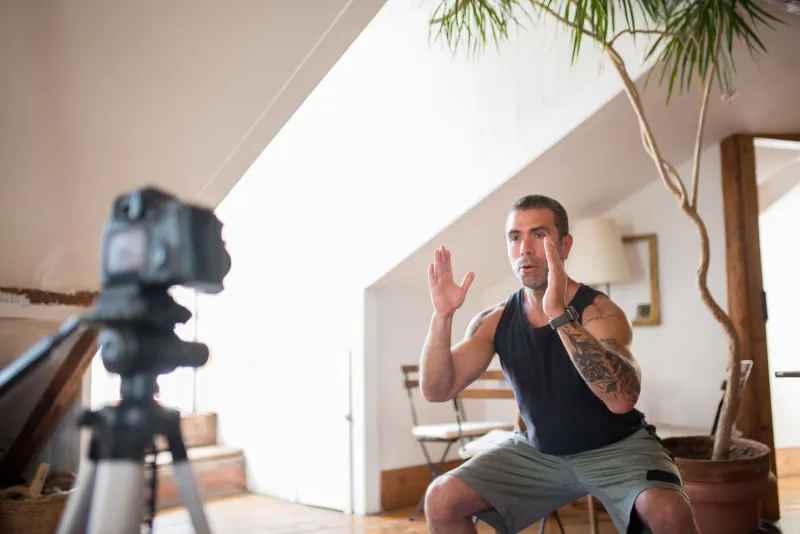
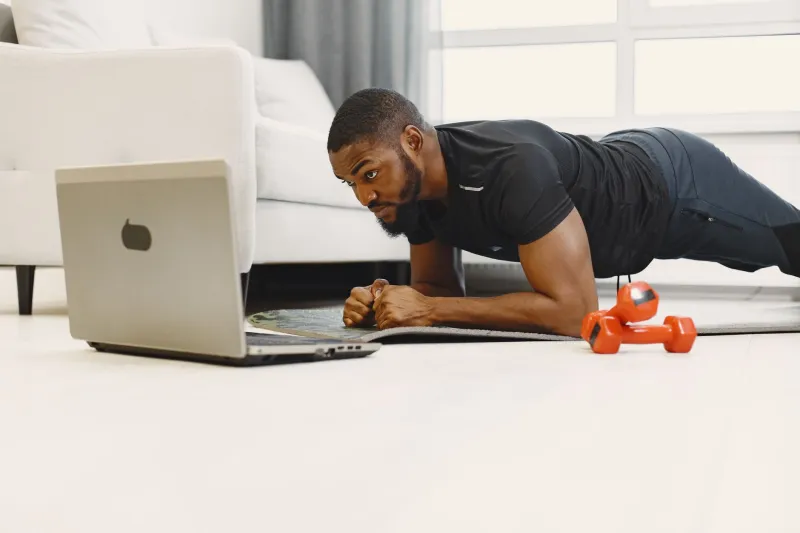
Let's be honest about something most fitness content won't touch: working out on camera is weird. Not scary-weird, not confidence-destroying-weird — just that low-grade, slightly itchy awareness that someone, somewhere, can see exactly what you're doing. Your form. Your effort level. Whether you quietly skipped that last set.
Here's what's interesting: that specific flavor of discomfort? It might actually be doing more for your health than any workout plan you've ever followed.
The Problem With Both Extremes
Think about the two ends of the fitness content spectrum. On one side, you've got the fully private solo workout — just you, your living room floor, and absolutely zero accountability. Research on self-regulation consistently shows that when no one's watching, we tend to negotiate with ourselves. We round down the reps. We call a 30-minute session at 22 minutes. We're not lazy; we're just human. Without external input, our internal standards get flexible fast.
On the other end, you've got the hyper-polished world of fitness influencer content. Six-pack lighting, perfectly timed cuts, and the kind of performance that makes you feel like a sweaty disaster by comparison. Studies on social comparison — particularly work building on Leon Festinger's foundational theory — suggest that when we measure ourselves against people who seem impossibly ahead of us, motivation doesn't spike. It craters. We disengage. We scroll past and eat chips.
Neither extreme is actually helping you build lasting habits. But there's a third option sitting right in the middle, and it lives in the slightly uncomfortable territory of live streaming.
What Psychologists Call the "Optimal Anxiety" Zone
Sports psychologists have long talked about something called the Yerkes-Dodson curve — the idea that performance improves as arousal (read: pressure, alertness, engagement) increases, but only up to a point. Push past that point and performance tanks. The sweet spot is moderate arousal: enough stimulation to sharpen your focus, not so much that you freeze up or shut down.
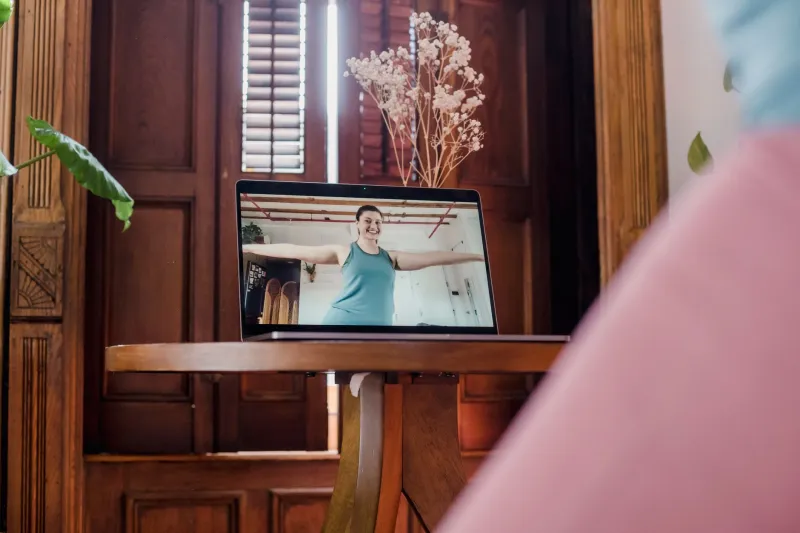
Live streaming creates that moderate arousal almost automatically. When you join a real-time class on a platform like Cellula Live, you're not performing for an edited audience or working in complete isolation. You're just... present. Visible, but not scrutinized. Watched, but not judged in slow motion. That combination nudges you right into the productive zone where you're alert, engaged, and just self-conscious enough to actually try.
That slight camera-awareness — the sense that your effort is real and observable — acts like a gentle external standard. You hold the plank a beat longer. You don't fake the breathing. You don't quietly walk the sprint.
The Difference Between Self-Consciousness and Performance Anxiety
It's worth drawing a line here, because these two things feel similar but function very differently in the body.
Performance anxiety is the kind of stress that comes with high stakes and high visibility. It floods the system with cortisol, narrows focus, and triggers avoidance. If you've ever dropped out of a fitness challenge because you were terrified of being judged, that's performance anxiety doing its thing.
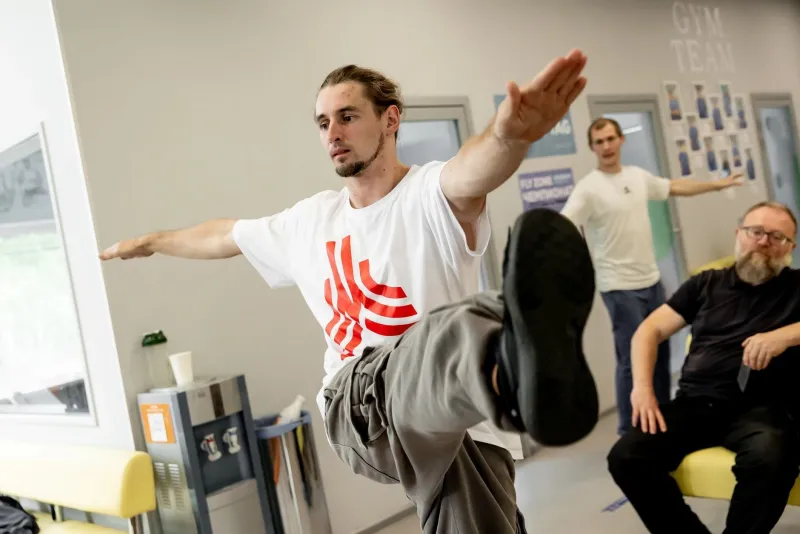
Self-consciousness — the milder, more manageable version — is something else entirely. It's the awareness that you exist in a social space, that your actions have some small audience. That awareness, when it's calibrated right, actually improves behavior rather than shutting it down. It's the mechanism behind why people are more honest in face-to-face conversations than in text messages, why people tip more when servers can see them, and why you probably push harder in a group fitness class than you do alone at home.
Live streaming hits that self-consciousness register almost perfectly. The camera is on, but it's not a spotlight. People are present, but they're also doing their own thing. The stakes are real but low. That combination is psychologically productive in a way that's genuinely hard to replicate.
Why Polished Content Can't Give You This
Here's something worth sitting with: pre-recorded, edited fitness content is designed to minimize discomfort. The instructor looks great, the music is perfectly timed, and the whole thing is engineered to feel smooth and aspirational. That's not a criticism — it's just what the format does.
But that smoothness comes at a cost. When everything is polished, your brain processes it more like entertainment than participation. You watch; you don't really do. And even when you do follow along, there's no live friction — no moment where you have to decide, in real time, whether to actually push through something hard while someone else can see you making that choice.
Live streaming introduces friction back into the equation. The instructor might notice you. The chat might comment. Other participants are visible, doing the work in real time alongside you. That friction isn't a bug. It's the feature that makes the experience stick.
The Habit Loop That Actually Holds
Behavioral research on habit formation — including work from Wendy Wood at USC, whose research on habit architecture is some of the most cited in the field — consistently points to context as the underrated driver of lasting behavior change. We don't build habits through willpower alone. We build them by creating environments where the desired behavior is the path of least resistance.
Live streaming creates a context that quietly stacks in favor of showing up and following through. The scheduled start time creates a commitment anchor. The presence of others creates social continuity. The mild camera-awareness creates just enough friction to keep you honest. And the real-time nature of the experience means you can't rewind, edit, or delay — you're in it, now, and that immediacy changes how you engage.
Over time, that context becomes the habit itself. You don't have to white-knuckle your way through a workout. You just show up to the stream, and the environment does a lot of the heavy lifting.
Learning to Sit With the Squirm
If you've avoided live fitness or wellness content because the camera-on feeling seemed like too much, it might be worth reconsidering what that discomfort is actually telling you. It's not a sign that you're not ready. It might be a sign that you're right at the edge of where real change happens.
The goal isn't to get comfortable enough that you stop noticing the camera. The goal is to stay in that productive middle ground — where the mild awareness of being seen keeps you honest without overwhelming you. That's not a performance. That's just a slightly more real version of the work.
And real, it turns out, is exactly what your health habits have been missing.