You're Your Own Best Coach — If You Can Actually See Yourself
Here's something worth sitting with: when you watch yourself exercise live — not a recording, not a highlight reel, but a raw, real-time video feed of your body actually doing the thing — your brain shifts into a completely different gear.
It's not vanity. It's neuroscience.
And if you've ever hopped into a live fitness class on a platform like Cellula Live with your camera on, you may have already felt this without quite being able to name it. That subtle heightening of attention. The way you suddenly care about your elbow position. The almost involuntary urge to fix your posture the moment you catch your own eye on screen.
That's not self-consciousness. That's your brain doing something genuinely remarkable.
The Mirror Isn't Doing What You Think It's Doing
Gym mirrors have been a fixture of American fitness culture for decades. Walk into any LA Fitness, Planet Fitness, or boutique studio from Brooklyn to Phoenix, and you'll find walls of reflective glass. The assumption has always been that mirrors help you correct form.
But here's the catch: a static mirror only shows you a single angle, in a fixed moment, with no record. Your brain processes that reflection passively — more like background information than actionable data.
Live video feedback is a different animal entirely.
When you see yourself on a live stream, your brain activates what researchers call the self-monitoring network — a cluster of regions including the medial prefrontal cortex and the anterior insula. These areas are deeply involved in self-awareness, interoception (sensing your own body from the inside), and error detection. In plain English: your brain starts treating the image on screen as a real-time performance review, not just a reflection.
The result? You become simultaneously the athlete and the observer. And that dual role changes everything.
Why "Live" Matters More Than "Recorded"
This is where things get genuinely interesting for anyone who's wondered whether a live fitness class is actually better than a pre-recorded one.
When you watch a recorded workout — even your own — there's a psychological distance. Your brain knows the outcome is already fixed. The stakes feel lower because, in a sense, they are. You can pause. You can rewind. You can check your phone.
Live is different. The present-tense quality of a live session triggers what psychologists call contingency awareness — the understanding that what you do right now directly affects what happens next. Your brain is not in replay mode. It's in performance mode.
Add live video of yourself into that equation, and something called the mirror neuron system gets pulled into the mix. Originally studied in the context of observing other people's movements, this system also activates when you watch yourself move — especially when the movement is happening in real time. You're essentially coaching yourself through observation, firing the same neural circuits involved in actually executing the movement.
This creates a feedback loop that recorded content simply can't replicate: see it, feel it, adjust it, repeat — all within the same breath.
The Injury Prevention Angle Nobody Talks About Enough
Form correction gets a lot of attention in fitness circles, but the conversation usually stops at aesthetics or efficiency. What doesn't get discussed nearly enough is how poor movement patterns accumulate into injury — often slowly, often invisibly, until something goes wrong.
Real-time self-observation disrupts that process early.
When your brain is actively monitoring your own movement through a live feed, it's more likely to catch compensatory patterns — those subtle, habitual cheats your body makes to avoid discomfort. The slight knee cave on a squat. The forward head creep during a plank. The asymmetric hip hike you've had for years and never noticed because you've never seen yourself from the front.
A gym mirror might catch some of this. But in a live class setting on a platform like Cellula Live, you've got something even more powerful: an instructor who can also see you, in real time, and call it out before it becomes a problem.
That combination — your own self-monitoring plus an expert external eye — is genuinely hard to replicate in any other format.
The Confidence Paradox
Here's the part that surprises most people: seeing yourself live doesn't make most exercisers more self-conscious over time. It actually does the opposite.
Initially, yes — turning your camera on in a live class can feel uncomfortable. American fitness culture has spent decades marketing an idealized version of the exercising body, and most of us have absorbed enough of that messaging to feel awkward about our real-time reality.
But research on self-efficacy — your belief in your own ability to execute a task — consistently shows that accurate self-observation builds genuine confidence, not the performed kind. When you watch yourself successfully complete a difficult movement, your brain logs that as evidence. Real, unedited, live evidence that you can do the thing.
Over time, that evidence accumulates. Your self-image as an exerciser starts to shift — not because someone told you that you were doing great, but because you saw yourself doing great, in real time, without filters.
That's a fundamentally different kind of motivation than anything a highlight reel can offer.
What This Means for How You Train
If you're currently doing most of your workouts through pre-recorded content — apps, YouTube, downloaded programs — you're probably not getting this feedback loop at all. And that's not a knock on those tools. They have real value.
But if you're trying to improve technique, prevent injury, or actually internalize new movement patterns rather than just going through the motions, live training with video feedback is worth taking seriously.
A few practical things to consider:
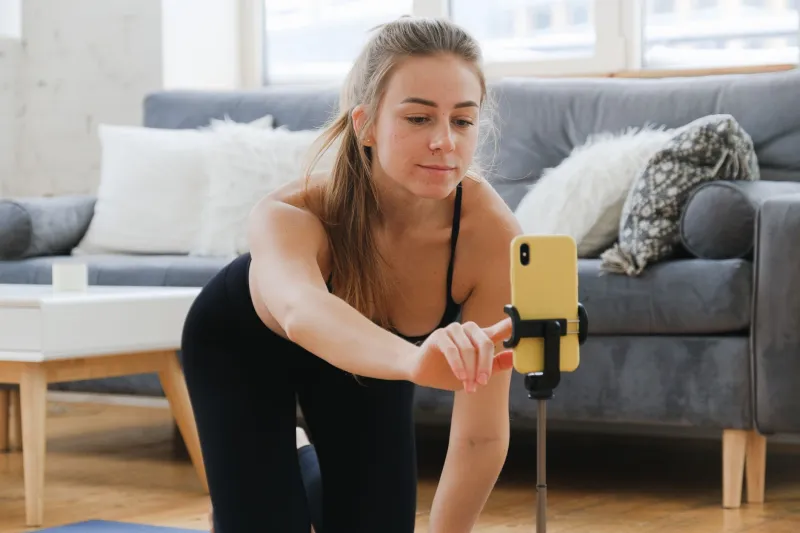
- Camera placement matters. Positioning your device so you can see your full body — front or side depending on the movement — gives your brain the most useful information.
- Don't just glance. Actually observe yourself with intention. Notice what your body is doing, not just whether it looks okay.
- Use instructors who engage with what they see. The live format only reaches its full potential when there's a real human on the other end responding to your actual movement, not a generic cue delivered to a faceless audience.
- Stick with it past the awkward phase. The discomfort of seeing yourself on camera usually fades within a few sessions. What replaces it is something much more useful.
The Bigger Picture
The convergence of live streaming technology and fitness science is still young, but the early signals are compelling. Platforms built around real-time interaction aren't just more convenient than in-person classes for a lot of Americans — they may actually be more neurologically effective for certain kinds of learning and habit formation.
Seeing yourself live, in motion, doing the work — it activates something in the brain that passive consumption of fitness content simply doesn't reach.
That's not a small thing. That might be exactly the missing piece.